
By Emily Herr
The Scoop Digital Newspaper: February 2025
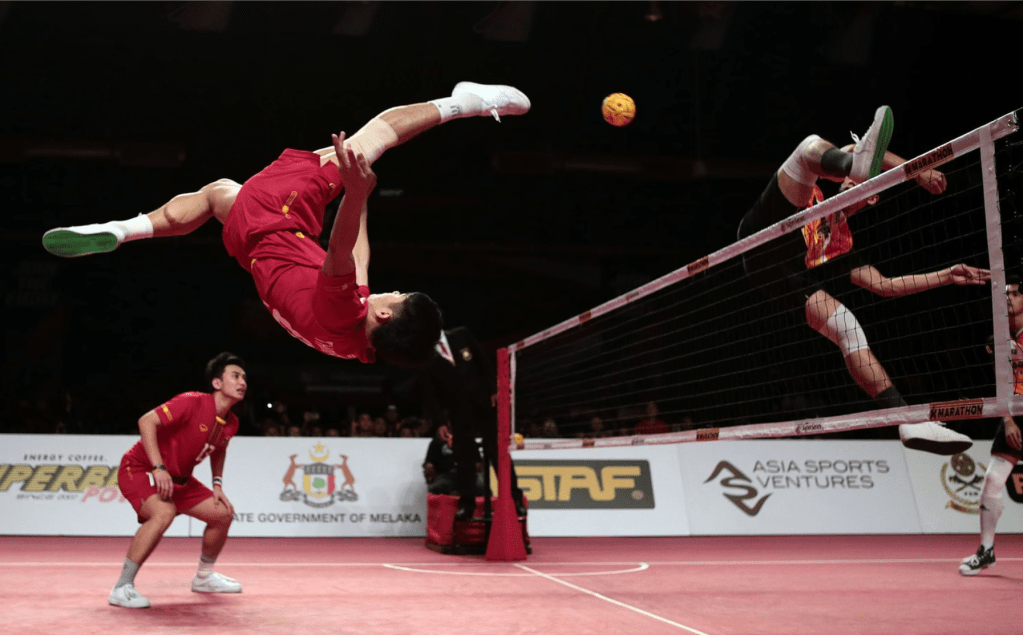
Sports are said to be one of America’s favorite pass times. There are so many different sports that demonstrate quality sportsmanship and athleticism. From the most well-known sports like basketball, football, baseball, and hockey to other sports like tennis and golf; there is something for everyone. But at All Sports Television Network we strive to bring you even more sports cover than that.
There are so many sports that broadcasting networks don’t think to cover. That is what we do at the All Sports Television Network. We want to bring you coverage on the even lesser-known sports. One of those sports is Sepak Takraw.
What is Sepak Takraw?
Sepak Takraw, also called Buka Ball, Kick Volleyball or Foot Volleyball, is a team sport based out of Asia. Originating in Penang, it was known as Sepak Raga Jaring. This sport was first founded in 1945. The modern style of this sport began in 1960 when officials from Malaysia, Singapore, Thailand and Myanmar met together to create rules for this game. That is when they named it Sepak Takraw.
This sport is played with a ball made of rattan, or plastic. There are two teams. Each team has two to four players on the court. Although the court more closely resembles a badminton court, it is associated with volleyball.
The rules only allow players to use their feet, knees, shoulders, chest and head to touch the ball. These rules are more closely related to soccer. Which is why many think of the sport as being a mixture of volleyball and soccer.
Regulating Sepak Takraw
Sepak Takraw is governed internationally by the ISTAF or International Sepaktakraw Federation. The ISTAF was created in 1988. The ISTAF is also responsible for major international tournaments for Sepak Takraw. There are three main tournaments that involve the sport of Sepak Takraw including the ISS or ISTAF Super Series, the IWC or ISTAF World Cup, the Malaysia’s Khir Johari Cup, and Thailand’s King Cup.

The History of Sepak Takraw
This history of Sepak Takraw is a fascinating one. Which makes it a little more surprising that it’s not more well known. The sport was even introduced in 1965’s Southeast Asian Games. The Southeast Asian Games was hosted in Kuala Lumpar, which was another interesting historical fact, since that was the same place that officials met in to discuss the sports rules and name in 1960. Now Sepak Takraw is considered Malaysia’s national sport.
The history of Sepak Takraw goes back farther than that. In fact, it is thought to have been introduced to Southeast Asia by the Chinese. The sport originated from the Chinese traditional game of Cuju. Cuju is an ancient military exercise. A lesser-known historical fact is that Cuju is also said to be the origin sport of soccer and is recognized as such by the FIFA or International Football Association.
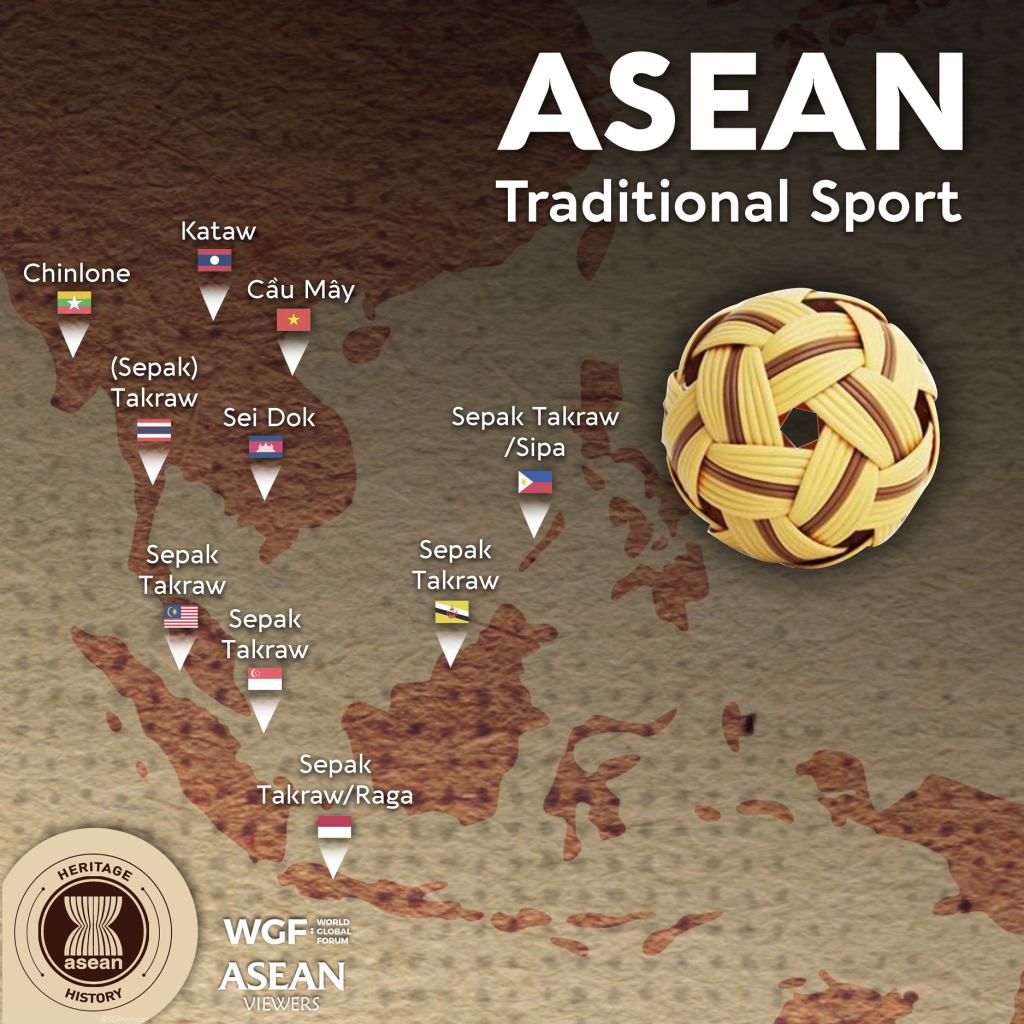
In Myanmar, Sepak Takraw is called “Chilone” and has been played for over 1,500 years. Chilone was meant to be a spectator sport and was used for entertainment purposes. There are a lot of Burmese martial arts and dance influences in Chinlone. There are other traditional sports that are similar to Sepak Takraw. These sports include:
- Malaysia (Sepak Takraw)
- Thailand (Sepak Takraw)
- China (Cuju)
- Indonesia (Sepak Raga)
- Philippines (Sipa)
When Sepak Takraw was first introduced as a sport it was not meant to be a competitive sport. In fact, it was meant to be a casual game to increase physical activity. It was more like an exercise and was used to improve dexterity and loosen limbs.
In the 1940’s Sepak Takraw started changing to the modern sport we see today. It was actually in 1935 in Seremban, at the celebration of Silver Jubilee of George V., that Sepak Takraw was first played on a court. It was played on a badminton court. There were two opposing teams. This was the first time the sport used similar rules as the modern day Sepak Takraw, and the first time it became a competitive sport.
One of the first tasks that were assigned to the ASTAF or Asian Sepaktakraw Federation was to translate the rules of Sepak Takraw into English. This was in response to the first worldwide competition known as the SEAP Games or the Southeast Asian Peninsular Games. One confusing fun fact about the first competitive game held in Kuala Lumpur was that the game was still called Sepak Raga. It wasn’t until 1967, during the fourth SEAP game, that the game became recognized by its name, Sepak Takraw.
Sepak Takraw was brought to Canada by the Lao people when refugees immigrated in the 1970’s. The sport gained popularity and became a sport that was introduced to schools. In May 1998 after introducing the sport to many schools and creating the ASEC or Asian Sports, Education & Culture International’s School Presentation Program, Canada organized its first tournament. They introduced a men’s, boy’s and girl’s teams.
Following the introduction of Sepak Takraw in Canada, they produced DVDs about the sport. Canada has since contributed a lot to the development of the sport.
Japan introduced the sport by playing in the 1990 Asian Games held in Beijing. However, since 2010 there are not any professional Sepak Takraw teams in Japan. But there are university level teams at Asia University, Chiba University, Keio University, and Waseda University in Japan.
The Philippines on the other hand compete internationally in Sepak Takraw, or as it is commonly known in the Philippines, Sipa. They have some of the most famous players known in the sport. Their lineup includes the following well-known Sepak Takraw players:
- Jason Huerta
- Reyjay Ortuste
- Mark Joseph Gonzales
- Josefina Maat
- Des Oltor
- Ronsted Cabayeron
- Sara Catain
Although most of the historical and modern background of Sepak Takraw is dedicated to Asia and Southeast Asia, the sport does in fact exist in the United States. It was originally organized by students from Northrop University in 1986. That was in Inglewood, California, but the sport was played in Los Angeles.
In the 1980’s Southeast Asians held soccer tournaments that featured Takraw events in several US states including Wisconsin, Michigan, Minnesota and California. A huge presence was in the Lao, Hmong and Thai communities in these states.
The sport spread in America when students played Sepak Takraw on campus and taught American students about the sport. This move, inspired Malaysia Airlines to sponsor a US team from the university. They sponsored the American team to attend the National Tournament in Kuala Lumpar in November 1987.
During that game the Northrop team played in a group of new international teams with Korea, Sri Lanka, and Australia. The US actually beat Sri Lanka and Australia and brought home a gold medal.
Modern Sepak Takraw

The modern form of Sepak Takraw is celebrated in Asia, Canada, Japan, the Philippines, and the United States. Now governed by ISTAF the ISTAF Super Series, the ISTAF World Cup, and the King’s Cup World Championship are held every year.
Sepak Takraw is now considered a regular sports event in the Asian Games and the Southeast Asian Games. As of date Thailand has won the most medals for the events.
Rules & Regulations of Sepak Takraw
Although there are basic rules set for Sepak Takraw, the court measurements and equipment vary depending on which tournaments and organizations are involved. It also depends on whether the sport is being played for recreational purposes or competitively. Still, the most common and well-known rules are those that are considered to be the international competitive rules and regulations.
In these rules and regulations there are two types of events categorized as the regu and the doubles regu. The regu category is played by three players on each team and the doubles regu is played with two players on each team.
The Sepak Takraw Court
The court, the net, the ball and the players all have specific rule requirements. The court is similar to that of badminton. The area of the court is 13.4 meters by 6.1 meters, the equivalent to 44 feet by 20 feet. The court is required to have an open area above it and must be at least at least 8 meters, the equivalent of 26 feet from the floor up.
Specifications are also required for the lines on the court. The width of the lines around the boundary of the court should be no more than 4 centimeters (1.6 inches) measured inward from the edge of the court. The boundary lines should be drawn at least 3.0 meters (9.8 feet) away from any obstacles. The center line should be 2 centimeters (0.79 inches) when drawn and should be equally dividing the right side and left side of court.
Additionally, where the center line meets the sidelines, there are quarter circles drawn on each side, from the sideline to the center line of the court and has a radius of 0.9 meters (2 feet, 11 inches) when measured and drawn outwards from the edges of the 0.9-meter (2 feet, 11 inches) radius.
The circle for serving is 0.3 meters in radius and should be drawn on the left and on the right side of the court, the center of which is required to be 2.45 meters from the back line of the court and 3.05 meters from the sidelines. There is a 0.04-meter line that should be measured and drawn outward from the edge of the 0.3-meter radius.

There are similar requirements for the net and ball. Specific measurements, materials, and assembly are instructed in the rules and regulations.
The Players
In each match of Sepak Takraw the players are on two teams known as regu. Each team has three players. Sometimes the teams consist of only two players, called doubles, or four players, called quadrants.
The player who stands on the back is called the Tekong, which is also known as the server. The other two players that stand close to the net, are placed one to the left and other to the right. The player on the left is called the feeder or setter, sometimes called a tosser. The player on the right is called the attacker or striker, sometimes called a killer.

Game Play
The rules state that one side should serve first. That side is required to start the first set. Whichever side wins the first set has the option to decide who serves next.
The throw must be executed as soon as the referee calls the score. If either inside player throws the ball before the referee calls the score, it must be re-thrown, and the team is given a warning.
During the serve, as soon as the Tekong kicks the ball, all the players are allowed to move around the court freely on their own side of the court.
The only way the serve is considered valid if the ball passes over the net, even if it touches the net before passing over it, it counts. And it must pass inside the boundary of the two net tapes and boundary lines of the opponent’s court.
Faults in the Game
The serving side has eight various faults that can be penalized against them during gameplay.
- If the inside player who is throwing the ball to the server plays with the ball, passes the ball to another player, bumps it, etc., after the score is called by the referee.
- If the inside player lifts their feet or steps on the line or crosses over the net (or touches the net) while throwing the ball.
- If the Tekong jumps off the ground to execute the service.
- If the Tekong does not kick the ball on the service throw.
- If the ball touches a serving side player before crossing the net into the opponent’s court.
- If the ball goes over the net but falls outside the court.
- If the ball does not cross to the opponent’s side.
- A player uses their hand(s) or any other part of his arm to facilitate the execution of a kick even if the hand or arm does not directly touch the ball, but it touches other objects or surfaces instead when doing so. 1
The serving and receiving can be faulted during the services if either create distractions or noise, or shouts at the opposing side’s players.
For both sides during the game there are seven faults that can be used to penalize against players’ teams during the game.
- Any player who touches the ball on the opponent’s side.
- Any part of the player’s body crosses over into the opponent’s court whether above or under the net except during the follow-through of the ball.
- Playing the ball more than 3 times in succession.
- The ball touching the arm.
- Stopping or holding the ball under the arm, between the legs or body.
- Any part of the body or player’s outfits e.g. shoes, jersey, head band, etc., touches the net or the post or the referee’s chairs or falls into the opponent’s side.
- The ball touches the ceiling, roof or the wall (any objects).2
Scoring System
In Sepak Takraw the way an official doubles match (ragu) is won by the best out of three sets. This means that in order to win the team has to win two out of three sets. Each of the sets is played up to 21 points.
When a team is playing an event or group match there are at least three ragu matches played back-to-back, using different players for each regu. The winner of these events or group matches is determined by who had the best of three regus. Again, making it so the team has to win two out of three regus played. Also, the winner of each individual regu is determined by the best of 3 sets, played up to 21 points.
When the game is being played, during the last of the three sets there is a change of sides when the team reaches 11 points.
If either of the sides commits a fault, regardless of whether they are the server or the receiver, a point is awarded to the opponent’s side.
Serving: teams alternate who serves every three points, regardless of who wins the point. In the event of a tie at 21-21, each of the two team alternates one serve each until a winner is determined.
Set: each set is won by the side who scores 21 points first with a minimum lead of two points and up to 25 points. If a tie occurs, at 21-21, the set is won by the side which gets a lead of two points, or when a side reaches 25 points, whichever occurs first.
Match: A match is won by the team who has won two sets. A team event match is won by the team that wins two regus.
Ranking: In group stages of tournaments or team events called round robins, the ranking in a group is determined by:
- The sum of the match wins; a match win gives 1 point.
- The sum of the set points.
- The difference in points +/- between the teams.

Where to Watch Sepak Takraw
You can watch all the latest Sepak Takraw games and news on the All Sports Television Network YouTube channel. All Sports Television Network airs sports and sports-related programming throughout the US 24 hours a day. It can be seen on broadcast television throughout the nation.
You can also watch All Sports Television Network on:



~~~~~~~~~~~~~~~~~~~~~~~~~~~~~~~~~~~~~~~~~~~~~
The Scoop Digital Newspaper
contact@thescoopdigitalnewspaper.blog
References
- International Sepaktakraw Federation (ISTAF) (2004). “Sepaktakraw: Laws of the Game” (PDF). Archived from the original (PDF) on 25 March 2009. Retrieved 29 July 2007. ↩︎
- International Sepaktakraw Federation (ISTAF) (2004). “Sepaktakraw: Laws of the Game” (PDF). Archived from the original (PDF) on 25 March 2009. Retrieved 29 July 2007. ↩︎


Leave a comment